Showing posts with label Butterfly Valley. Show all posts

kingBIRD: Butterfly Valley: Permanent Installation VII

Just living is not enough, said the butterfly...

...One must have sunshine, freedom and a little flower. -Hans Christian Andersen
Home means something different to everyone. I always work with things in pairs or with contradictions and polarity, where one thing becomes it's other. Or paradoxes. I believe you can never have one, without also having the other, in one way or another. We might not always be aware - but it is always there. It is the other that draws the outline of the one. Most people know the feeling of  “when you're safe at home you wish you were having an adventure; when you're having an adventure you wish you were safe at home”. So to have a place you feel at home, it helps to have been away, and here I have chosen the last part of having been away the returning. The returning is widely an ignored or neglected word, everyone these days are so focused on going somewhere.
        
Of course, expecting home as only being possible existing in or as a location, whether it is more or less well known, is horribly narrow-minded and limited.  As it is said “home is not where you live, but where they understand you”. Sometimes, when we think back it might not always be the most luxurious places we have lived that stand out,  because "a house is made of walls and beams; a home is built with love and dreams.”

Sometimes it is said that a “home is a place you grow up wanting to leave, and grow old wanting to get back to". If that’s the case, I personally have to wait and see. I have left home and allthough, I'm not 18 anymore I don’t think I'm old enough to be called old. But I don’t think it is that important. I don’t think we shall wait for or expect to find the right place or solution to find our happiness; I rather think we should find inspiration from the butterfly: It goes where it pleases and it pleases wherever it goes." After all “we are all visitors to this time, this place. We are just passing through. Our purpose here is to observe, to learn, to grow, to love... and then we return home”. So to choose to put the butterflies on the wall was a symbol of contradictions of the word home and returning. One of the most beautiful descriptions of a paradox I know, and still makes perfect sense is about:

"The butterfly that counts not months but moments, and has time enough"


I push my hand up to the sky, Shade my eyes from the sun,  as the dust settles around me, suddenly night time has begun. You knew you were lost, but you carried on anyway, you knew you had no time, but you let the days drift away.
 

The words above is from the band Editors song the racing rats. I was reminded about these words while making this work. The clue about making this work is returning. The thing is that I was born here, in one of the flats surrounding the garden.  Below is a picture from that time.

kingBIRD: Butterfly Valley: Permanent Installation V

Images from the process


I've been working in two different studios for this installation. My former studio which is located in the heart of the city center. The other one in the picture below is Lone Kirketerps studio in the urban harbour areas. In the images above are the butterflies glazed and ready to go into the kiln for the firing.


kingBIRD: Butterfly Valley: Permanent Installation III

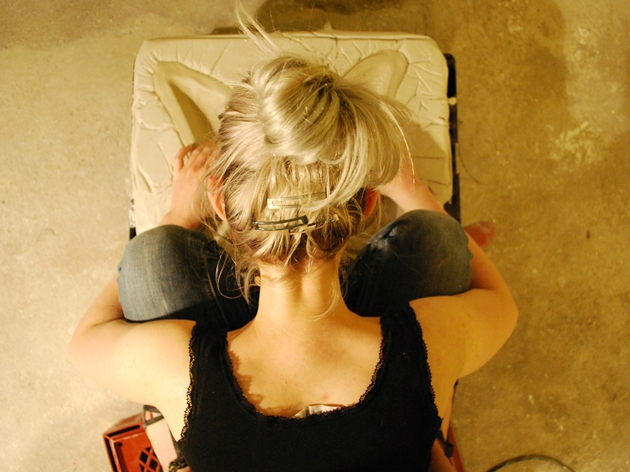
Making the plaster moulds


Foam board, pins, plastic, water and plaster. It's all I need. I'm a simple girl. Well, some time, good judgement and a little patience helps too.


Between the picture above and below, something funny happened, but I was alone so I couldn't catch it on camera. When I say funny, I'm using irony, or it is true in that manner - it would have been fun for you! And for me; less entertaining! I was making plaster moulds. Plaster moulds are a great tool for clay. You can press the clay into the plaster mould and it picks up every detail from the mould and the clay releases very easily from the plaster surface without sticking to it.

But making these moulds can be a bit of a nightmare for some of us. I do have some friends who really enjoy plaster work and make the most elaborated and truly amazing looking moulds. I don't hope they read this post and see these moulds. But the thing is; I'm the true genius of course, why spend more time than necessary on some moulds that are only going to be used a few times? (And I haven't - only fools get trapped by tools ;-). Of course, this is not true at all, but in this case there are more important things to spend time on during the whole process, and time is an issue for this project, so I really have to make some shortcuts which make function beautiful.

But back to the fun, what you missed out on (and the reason why the camera was banned from the scene) was me and 40 litre of plaster dancing round in the studio. While I was trying to persuade it to stay in the right place until it had set, without me being trapped into the big bloc of plaster as well. I did text a friend (just so someone actually knew about this big drama that was going on) to tell him that I was contemplating on the possible outcomes on pouring big amounts of plaster into card board boxes;
  1. Would be a very brilliant and time saving idea leaving no cleaning
  2. Or would it leave me scraping hardened plaster of the floor for hundreds hours
He just answered dryly; if it was him he would choose a very stable box for the job!? He's a sensible guy. And I was happy to answer him the next day, when he asked about the cardboard box and the plaster, that two butterfly moulds was waiting for me!


kingBIRD: Butterfly Valley: Permanent Installation II

Making templates for the plaster mould


I flew to Denmark to start on the installation Butterfly Valley. I arrived late evening, had dinner and went straight to bed. Next morning, I started to work. Everything has to be made from scratch, moulds and everything and I need to adjust to other peoples studios. I love to visit and work in my friend’s studios, although I don't have my tools and stuff, and materials have to be bought as well. It takes some planning to be on top of that. It looks like I'm trying out this planning in the picture below. If I'm succeeding is more
questionable.

I drew some butterfly shapes on tracing paper and scaled them up with a good old-fashioned-analogue method (I should almost make a tutorial, how that is done correctly). Not, that I would decline a printer or a photocopying machine next time, but sometimes it’s just easier done by hand.

Then I cut up the outline of the butterflies in foam board. Tomorrow, I will use them to form plaster models of the shape I want for the butterflies.


kingBIRD: Butterfly Valley: Permanent Installation I

Permanent installation in Aarhus, Denmark


I've been commisionned to make an installation for a public space in a garden/park belonging to a residential area in Aarhus, Denmark.

When doing an installation like this where people actually live there are many important aspects to take into conderation, practically as well as aesthetically. Doing exhibitions or works for a gallery or a museum venue, you can more or less do as you please as long as the health and safety guy is happy. And if the viewer doesn't like the work he or she can just look the other way. But placing your work permanently in a space where people live, you "force" your work upon them. They cannot escape it and are confronted by it every time they walk by it.

Basically, the work kinda has to last forever and looking good doing so. But one thing is actually really clever; Clay, the material. It might not be the easiest material to work with, it's fragile and breakable. But it can also be done in every shape and in extremely vivid and vibrant colours that will not fade in the sun or otherwise become worn out due to weather. So, it's meant to last forever unless something unexpected happens.

Making a work where people live, I wanted it to be about life in a beautiful and cheerfull way. Encouraging and celebrating. There were three keywords that I immediately got to think of; Home of course and then the two words returning and butterflies. Later, I will tell you more about these three keywords.

Below, you can the first sketches of my installation.


kingBIRD: Butterfly Valley

This project is inpired by the poem 'Butterfly Valley – a requiem' written by the Danish poet Inger Christensen.

A requiem is a death mass. Although death is the central scene in “Butterfly Valley” the poem is also a tribute to our fragile lives.

Form: The poems are written in the form of a classic, rhymed sonnet where rigid composition and repetition are the keystones. The form is ancient and very rigid, but it's the strength of the poem that the lines are repeated and translated into a new context and therefore changing significance. The constant recurrence patterns, shifting meanings and strict use of repetitions can be seen as process searching for cognition. In the classic sonnet there is an expectation that the text contains both an observation and a perception of something and an interpretation or an epistemological conclusion of those.

What is happening in the poem: The poem opens up with a spectacular sight of butterflies fluttering up in the midday heat in a valley in south Europe – exuding colour and warmth. For the narrator the flying butterflies awake glimpses of childhood memories, and thus begins the unfolding of the central topics of the poem; memory, nature, love, life and death. The narrative self is mirrored in nature and realizing herself as being enrolled as a part of it.

Death: The awareness of death is becoming more progressive throughout the poem. In the last sonnet the narrative self both reconciles herself with everything being finite, but also that the world still contains many moments of happiness.

kingBIRD, Butterfly Valley, 2009, ceramic
Why this inspires me: Describing a poem’s form and knowledge of butterflies is quite concrete observations and interpretations that can bring you some way into the understanding of the poem, but here the poem starts to bristle against. If these concrete descriptions are to make any sense the reader must go a step further and surrender the mind and just go into the maze of the poem. The sonnets are playing around, changing from concrete descriptions to liquid pictures and the sensory impressions change from the near to the outreach of cosmos. The contrast between the poem’s rigid composition and the feeling of the transient fluttering butterflies is elegant.

The built-in repetitions of the Sonnet Crown (Lines put into new contexts) are forcing the reader constantly to correct his or hers understanding of the poem. A reader trying to organize the poetry universe in a linear or hierarchical structure fails, because the universe is born labyrinthine. Nor is it possible to analyze the sonnet individually in order to assemble the partial analysis into an overall interpretation. The contrast between the tight composition of the poem and the feeling of the transient fluttering butterflies ensures that you must go along with the playful nature of the sonnet if you want an answer to your questions.